Blog · October 16, 2026 · 6 min read
Why You Can't Just Build Your Own ChatGPT
A founder asks me this most months. Here is the honest answer in plain words: what a model is, what training costs, why only a handful of labs do it, and what a company means when it says it has built its own AI.
People ask me this most months, usually a founder who has just watched a demo. "Why can't we build our own ChatGPT? We have good developers." The short answer is that nobody builds one, not even most AI companies. The long answer takes about six minutes and no technical background. Here it is, drawn on a blackboard first and written out below.
A model is a giant pile of numbers
Strip the branding off Claude, GPT or Gemini and what is left is a file of numbers, a few hundred billion of them in the big models. There are no words in it and no list of facts.
The way I picture it is a mixing desk, the kind a sound engineer sits behind, covered in knobs. Now make the desk the size of a city and give it a few hundred billion knobs. Every knob is set to some number. Text goes in one end, the knobs shape it, and the next word comes out the other end. The settings of the knobs are the model. That is all a model is.
Nobody sets those knobs by hand. Nobody could. They get set by a process called training.
Training is a guessing game
Take a sentence from the internet and hide the last word. "The cat sat on the ___." Show it to the model and let it guess. Early on it guesses garbage, "dog" or "purple". It is wrong, so you nudge every knob a tiny bit in the direction that would have made the right word slightly more likely. Then you do it again with the next sentence.
Now do that trillions of times, a different sentence each time. The big models are trained on most of the text on the public internet plus a great deal of books and code. Put together, it is every book in every library you have ever walked into, read a few times over. By the end, the knobs are set so well that the model can finish almost any sentence a human could write, in any language, about anything.
The model has no list of facts inside it. The knowledge lives in how the knobs ended up set, after trillions of nudges.
The bill
This is where "we have good developers" stops being relevant. The guessing game runs on a special kind of chip called a GPU. One of the chips the labs use costs more than a car.
A big training run does not use one chip. It uses tens of thousands of them, wired together in a building built for the purpose, running flat out for months. The electricity alone is the power bill of a small town. Sam Altman has said GPT-4 cost more than $100 million to train, and Dario Amodei at Anthropic has said the current generation is closer to a billion.
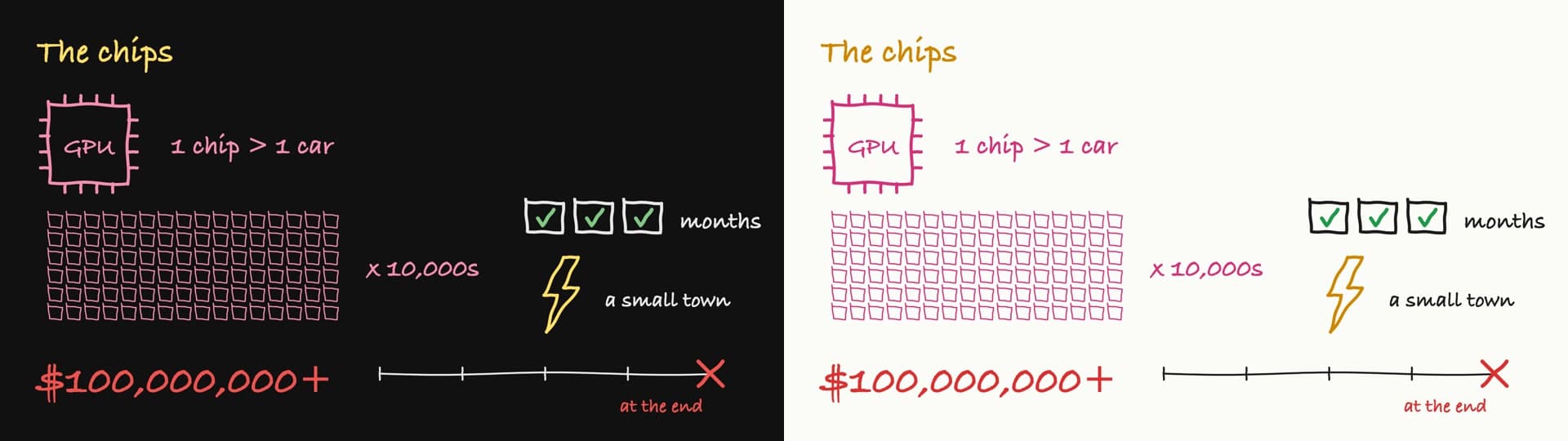
And you find out whether the run worked at the end. If the data mix was off or the recipe had a bug, you learn that after the months and after the money. The labs employ teams whose whole job is to reduce that risk, and they still get runs wrong.
Finishing sentences is not the same as helping
Suppose you had the money and the chips and the run worked. What you have now is a model that finishes sentences. Ask it a question and it may answer, or it may carry on writing more questions, because that is what text on the internet looks like. It is not a helper yet.
To get from there to something like ChatGPT, thousands of people sit and rate its answers. Good, bad, good. Too long, made that up, refused for no reason. Each rating nudges the knobs again. That is how a model learns to follow instructions, to admit when it does not know, and to say no to things it should not do. The exact recipe for this part is one of the most closely guarded secrets in the industry, and every lab's recipe changes every few months.
Answering costs money too
Training is paid once. Answering is paid every day after. Every question anyone types into ChatGPT runs through those same knobs on those same chips. Millions of people, all day, every day. That is why the labs keep building data centres after the model is finished, and why even the labs with the best models struggle to make money on them.
So who does build one?
A handful of labs. OpenAI, Anthropic, Google, Meta, xAI, a few in China, and a short list of others with the money to try. Everyone else, including nearly every AI company you have heard of, uses one of theirs. That is the sensible choice, and it is the one I make for clients.
What you can build
You rent one. Every big lab sells access to its model by the request, so you pay cents per answer and never think about chips. From there you have three real levers, and together they are what almost every "our own AI" product is made of.
- 01Give it your documents. The model has never seen your contracts, your support history or your price list. You can hand it the relevant pages at the moment it answers, so it replies from your material instead of from memory. This is most of what people mean by "trained on our data", and it needs no training at all. I keep a checklist for doing it well.
- 02Give it rules. Who it is, what it must never say, what to do when it is unsure, when to hand off to a human. Plain written instructions, read before every conversation. Getting these right is most of the work in a good product.
- 03Nudge a few knobs. Some labs let you run a small round of the rating game on your own examples. This is called fine-tuning. It changes the model's style and format, not its knowledge, and it costs hundreds or thousands of dollars rather than hundreds of millions. Most products never need it.
The engine is theirs. The data, the rules, the workflow and the thing it plugs into are yours to build, and that is where the value is anyway. People choose a product because it knows their business and does the job, whichever engine is underneath.
But what about open source?
Some labs give their finished models away. Meta's Llama and DeepSeek's models are files you can download and run on your own servers, which matters when your data cannot leave the building. Two things do not change. You still did not train it, so you are still trusting someone else's recipe. And running it still needs those chips, so for most teams it costs more than renting and performs a step behind the best paid models. It solves the data question. It does not change the economics.
One question to ask the next vendor
When a company tells you it has built its own AI, ask which model is underneath. "GPT-5 with our documents and rules" is an honest answer. "Llama on our own servers" is an honest answer. "Our own, from scratch" should give you pause, unless the company is also one of the five or six that can afford it.
If you want this explained to your own team, the video is on YouTube and free to share. If you want the engine rented, wired to your data and made to behave like your company, that is the work I do, and the contact page is the place to start.
Questions people asked
- Can a company build its own ChatGPT?
- Not from scratch, unless it has a few hundred million dollars, tens of thousands of GPUs and a research team. When a company says it has its own AI, it almost always means a rented model from OpenAI, Anthropic or Google combined with its own documents and rules. That combination is the right approach for nearly everyone.
- How much does it cost to train a model like GPT-4?
- Sam Altman has said GPT-4 cost more than $100 million to train. Dario Amodei of Anthropic has said current frontier runs are around a billion. Those figures cover chips and electricity for one run, before salaries and before the runs that failed.
- What does 'trained on our data' usually mean?
- Usually that the model is shown the relevant company documents at the moment it answers. The model itself is unchanged. This is called retrieval, it needs no training, it works well, and it keeps the data under your control.
- What is fine-tuning?
- A small round of the training game on your own examples, run on a model someone else already trained. It changes tone, format and consistency, not knowledge. It costs hundreds or thousands of dollars rather than hundreds of millions, and most products never need it.
- Does open source mean I can build my own?
- Open-weight models such as Llama and DeepSeek can be downloaded and run on your own servers. You still did not train them, and running them needs GPUs, so renting is cheaper for most teams. Use them when your data must stay in the building.
- What is a GPU and why does it matter here?
- A chip built to do millions of simple calculations at once, originally for video games. Training and running a language model is almost entirely that kind of maths. The chips the labs use cost tens of thousands of dollars each, and one frontier training run uses tens of thousands of them for months.
Haider Farooq is an AI engineer and data scientist based in Lahore, Pakistan — core engineer on TryCook.ai, developer at Aligno, and creator of MarkSafe.net. He builds agentic AI systems, RAG pipelines, and automation for teams worldwide. Work with him.